
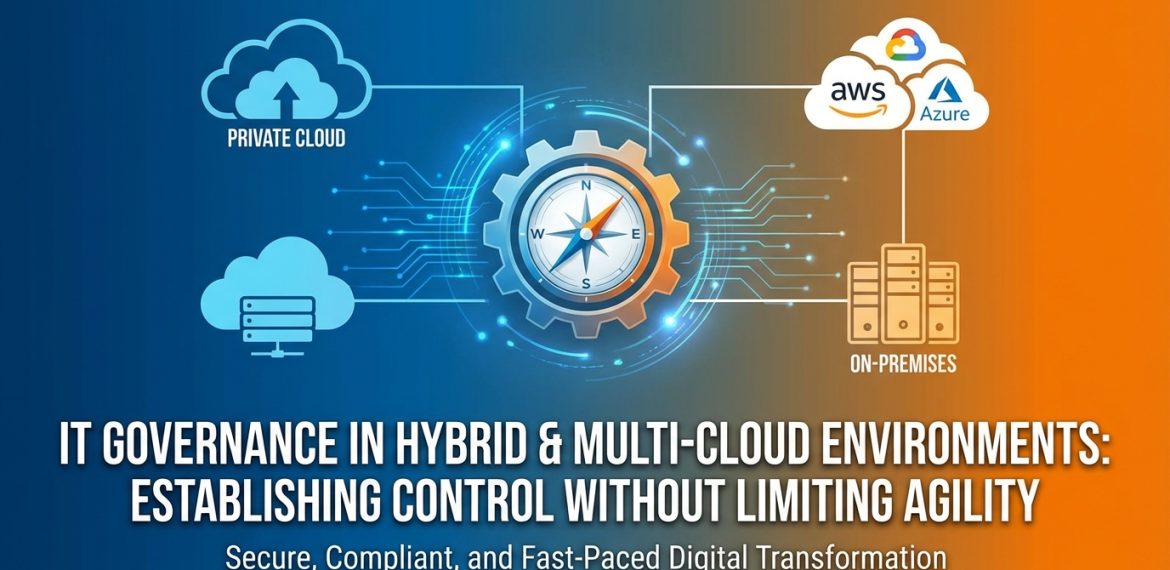
IT Governance in Hybrid and Multi-Cloud Environments: Establishing Control Without Limiting Agility
IT Governance in Hybrid and Multi-Cloud Environments: Establishing Control Without Limiting Agility
 Divyendra Kumar
 As organizations accelerate cloud adoption, few operate in a single, unified environment. Instead, they manage a mix of on-premise infrastructure, private cloud platforms, and multiple public cloud providers. While this hybrid and multi-cloud approach offers flexibility and scalability, it also introduces new governance challenges.
IT governance in such environments is no longer just about policy documentation or compliance audits. It is about establishing visibility, accountability, and control across distributed systems – without slowing innovation or creating operational bottlenecks.
The Complexity of Hybrid and Multi-Cloud Landscapes
Hybrid and multi-cloud strategies evolve for practical reasons. Organizations may retain on-premise systems for regulatory or latency requirements, adopt one cloud provider for core workloads, and leverage another for analytics or specialized services. Over time, this layered architecture increases operational flexibility – but also increases complexity.
Common challenges include:
Inconsistent security configurations across platforms
Limited visibility into cross-cloud data flows
Cost management difficulties
Fragmented identity and access controls
Vendor dependency and integration risks
Without strong governance, the flexibility of multi-cloud environments quickly becomes difficult to manage.
Governance Is No Longer Optional
In distributed environments, governance ensures that IT decisions align with business objectives and risk tolerance. Without governance, teams may deploy resources rapidly but without consistent oversight.
Governance provides structure in areas such as:
Security standards and access management
Resource provisioning and approval workflows
Cost tracking and accountability
Data protection and compliance alignment
Performance monitoring and incident management
Rather than restricting agility, effective governance creates the foundation for sustainable growth.
Balancing Agility and Control
One of the biggest misconceptions about IT governance is that it slows down innovation. In reality, poorly defined governance slows organizations more than well-designed frameworks ever could.
When governance is embedded into operating models and automation workflows, teams can move quickly while remaining compliant and secure. For example, automated provisioning templates can enforce security policies without requiring manual reviews for every deployment.
The goal is not rigid control – it is intelligent oversight supported by automation and transparency.
Identity and Access Across Environments
In hybrid and multi-cloud architectures, identity becomes the primary security perimeter. Users, applications, and services interact across environments, often without traditional network boundaries.
Strong governance requires centralized identity and access management, including:
Unified authentication mechanisms
Role-based access controls
Continuous monitoring of privileged access
Clear ownership of access approvals
Without consistent identity governance, security risks multiply rapidly across environments.
Financial Governance and Cost Visibility
Multi-cloud environments often obscure spending patterns. Different providers use different pricing models, making consolidated visibility difficult.
Financial governance frameworks help organizations:
Track spending across platforms
Allocate costs to departments or projects
Identify inefficiencies or underutilized resources
Forecast future expenditures
Aligning IT governance with financial accountability ensures that cloud growth remains sustainable.
Data Governance in Distributed Systems
Data frequently moves between on-premise systems and multiple cloud platforms. Without strong governance, organizations lose control over where data resides, how it is processed, and who can access it.
Effective data governance in hybrid environments requires:
Clear data classification policies
Defined data residency controls
Monitoring of cross-cloud data transfers
Encryption and lifecycle management standards
These measures protect sensitive information while enabling collaboration and analytics.
Operational Governance and Standardization
Operational consistency is critical in multi-cloud environments. Different platforms may have unique management tools, monitoring systems, and operational procedures.
Standardized operating models reduce variability and improve reliability. This includes consistent processes for:
Incident management
Change control
Performance monitoring
Backup and disaster recovery
Governance ensures these processes function cohesively across all environments.
Avoiding Vendor Lock-In
One strategic objective of multi-cloud adoption is reducing vendor dependency. However, without governance, organizations may unintentionally create new forms of lock-in through proprietary services and tightly coupled integrations.
Governance frameworks should evaluate architectural decisions to maintain portability and flexibility where appropriate.
Building a Governance Framework That Evolves
Hybrid and multi-cloud governance cannot be static. As platforms evolve and business needs change, governance models must adapt.
Successful organizations treat governance as a living framework, reviewed periodically and refined as environments mature. This ensures alignment between business objectives, risk management, and technological innovation.
How Buxton Can Help
Buxton Consulting supports organizations in designing and implementing governance frameworks tailored to hybrid and multi-cloud environments.
We assess current architectures, identify visibility and control gaps, and define governance models that align with operational and strategic priorities. Our expertise spans infrastructure, security, cost management, identity governance, and compliance alignment.
By integrating governance into operational processes and automation workflows, Buxton helps organizations achieve both agility and control – ensuring distributed IT environments remain secure, efficient, and aligned with business goals.
Conclusion
Hybrid and multi-cloud environments provide flexibility and resilience, but without structured governance, they introduce risk and inefficiency. Effective IT governance establishes clarity across platforms, aligns technology decisions with business objectives, and enables innovation without compromising control.
Organizations that invest in adaptive governance frameworks gain greater visibility, stronger security, and improved cost management. In a distributed digital landscape, governance is not a constraint – it is a strategic enabler of sustainable growth.