
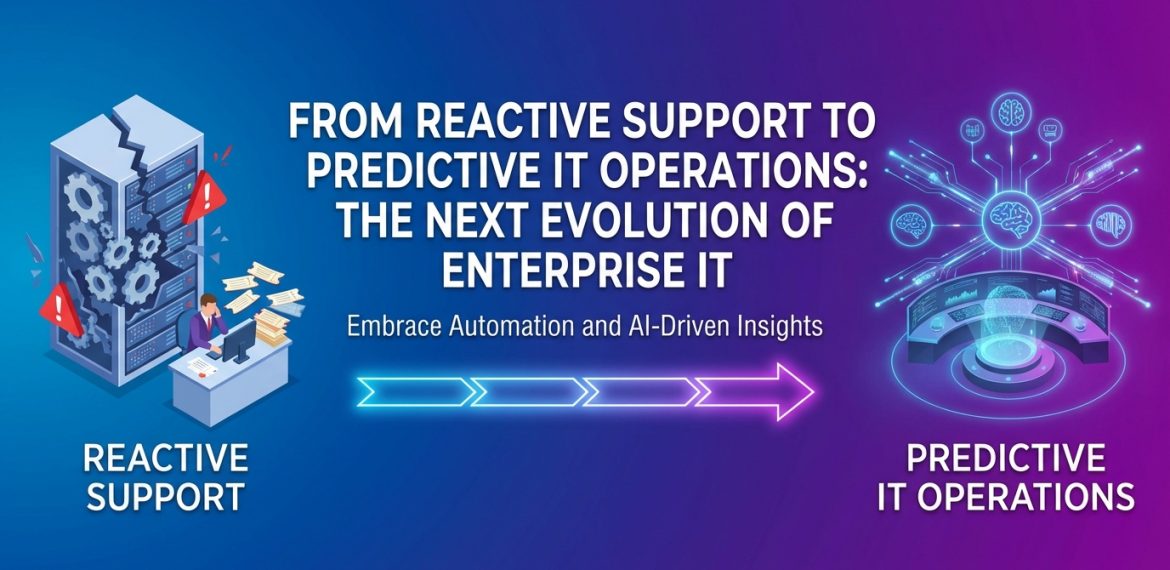
From Reactive Support to Predictive IT Operations: The Next Evolution of Enterprise IT
From Reactive Support to Predictive IT Operations: The Next Evolution of Enterprise IT
 Divyendra Kumar
 For many years, IT operations were built around a reactive model. Systems were monitored, alerts were generated, and teams responded when something failed. While this approach worked in slower, more predictable environments, it is increasingly inadequate in modern enterprises where digital services must operate continuously and at scale.
As infrastructure becomes more dynamic and business expectations rise, organizations are shifting toward predictive IT operations. This model leverages monitoring intelligence, automation, analytics, and operational discipline to anticipate issues before they disrupt business operations.
Predictive IT operations are not about eliminating incidents entirely. They are about minimizing impact, shortening recovery time, and identifying patterns that allow proactive intervention.
Why Reactive IT Models No Longer Scale
Reactive IT models assume that issues are occasional and manageable through manual intervention. In today’s distributed environments – where cloud platforms, APIs, third-party integrations, and remote users interact constantly – this assumption no longer holds.
Reactive models often struggle because:
Alert volumes overwhelm support teams
Root cause analysis becomes time-consuming
Downtime directly impacts customers and revenue
Infrastructure changes happen faster than documentation
Manual processes cannot keep pace with system growth
As environments scale, the cost of reacting to every issue increases significantly.
What Predictive IT Operations Really Mean
Predictive IT operations rely on continuous monitoring, data analysis, and pattern recognition to detect early warning signals. Rather than waiting for failures, teams use performance trends, anomaly detection, and automated insights to prevent disruption.
Key characteristics of predictive operations include:
Unified visibility across infrastructure and applications
Automated correlation of events and alerts
Trend-based performance analysis
Early detection of abnormal system behavior
Integration of monitoring with incident workflows
This approach transforms operations from firefighting to strategic management.
The Role of Observability and Monitoring
Traditional monitoring tools focus on uptime and threshold-based alerts. Modern predictive operations require deeper observability, including insights into system dependencies, latency patterns, user behavior, and application performance.
Effective observability enables organizations to:
Understand how components interact
Identify bottlenecks before they escalate
Correlate events across platforms
Detect performance degradation early
With comprehensive observability, teams gain context rather than isolated alerts.
Automation as a Force Multiplier
Predictive IT operations depend heavily on automation. Automated remediation, scaling, and recovery reduce dependency on manual intervention and improve response consistency.
Automation can support:
Restarting failed services
Scaling infrastructure during demand spikes
Applying configuration corrections
Triggering predefined recovery workflows
When combined with predictive analytics, automation allows issues to be resolved before users experience disruption.
Reducing Operational Noise
One of the most significant barriers to operational maturity is alert fatigue. When monitoring systems generate excessive or redundant alerts, teams struggle to distinguish critical signals from background noise.
Predictive models prioritize alerts based on impact and context, reducing noise and allowing teams to focus on meaningful risks. Over time, this improves efficiency and reduces burnout.
Linking Operations to Business Outcomes
Predictive IT operations are most effective when aligned with business priorities. Instead of focusing solely on technical metrics, organizations measure impact in terms of service availability, user experience, and revenue continuity.
This alignment ensures that operational improvements directly support strategic objectives rather than isolated technical benchmarks.
Cultural and Organizational Shifts
Moving toward predictive operations requires more than new tools. It demands cultural change. Teams must embrace data-driven decision-making, cross-functional collaboration, and continuous improvement.
Operational maturity grows when:
Incident reviews focus on learning, not blame
Data insights drive optimization efforts
Teams share responsibility across platforms
Leadership supports proactive investment in monitoring and automation
Without organizational alignment, predictive tools alone cannot deliver meaningful change.
How Buxton Can Help
Buxton Consulting helps organizations transition from reactive support models to predictive IT operations built on visibility, automation, and measurable outcomes.
We begin by assessing current monitoring frameworks, incident management processes, and operational maturity. Our team identifies visibility gaps, alert inefficiencies, and opportunities for automation.
Buxton supports implementation of observability platforms, optimization of incident workflows, integration of automation, and alignment of operational metrics with business goals. Through managed services and operational support, we ensure predictive capabilities remain sustainable and continuously improved.
Conclusion
In modern digital enterprises, reactive IT operations are no longer sufficient. As environments grow more complex and customer expectations increase, organizations must anticipate issues rather than simply respond to them.
Predictive IT operations provide the structure, intelligence, and automation required to maintain reliability at scale. By investing in visibility, analytics, and operational discipline, enterprises strengthen resilience and create a foundation for sustainable digital growth.
Predictive operations do not replace human expertise – they enhance it. And in a world where disruption is constant, anticipation becomes a strategic advantage.