
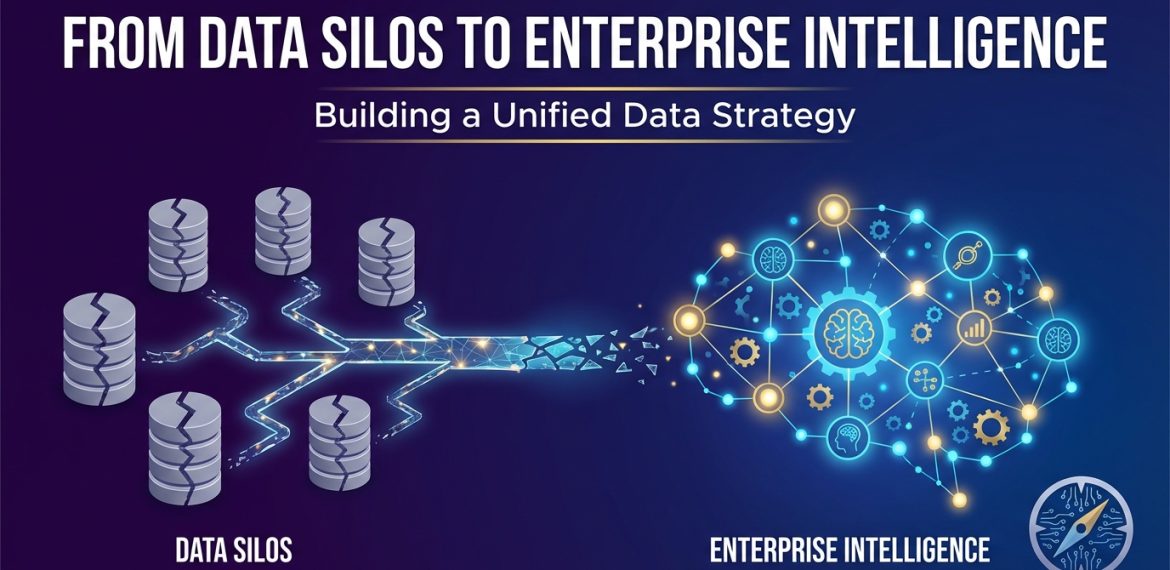
From Data Silos to Enterprise Intelligence: Building a Unified Data Strategy
From Data Silos to Enterprise Intelligence: Building a Unified Data Strategy
 Divyendra Kumar
 In most organizations, data exists everywhere but clarity exists nowhere. Sales teams rely on CRM systems, finance depends on ERP platforms, operations manage supply chain applications, and analytics teams extract data into separate reporting environments. Each system generates valuable insights, yet when these systems operate independently, decision-making becomes fragmented.
A unified data strategy transforms scattered information into enterprise intelligence. It aligns data architecture, governance, integration, and analytics under a single vision – enabling organizations to move from reactive reporting to proactive, data-driven leadership.
The Hidden Cost of Data Silos
Data silos emerge naturally as departments adopt tools tailored to their needs. While these systems serve specific functions effectively, the absence of integration creates duplication and inconsistency.
The impact of silos often includes:
Conflicting reports across departments
Manual reconciliation processes
Delayed access to critical insights
Poor visibility into enterprise performance
Reduced trust in data accuracy
Over time, leadership decisions rely more on interpretation than evidence, weakening strategic alignment.
Why Modern Enterprises Need Unified Data Architecture
Digital business models depend on real-time visibility. Customer experience optimization, demand forecasting, supply chain resilience, and financial planning all require consistent and timely information.
A unified data architecture enables:
Consolidated reporting across business units
Real-time dashboards and analytics
Seamless integration between operational systems
Scalable data storage and processing
Reliable inputs for AI and automation initiatives
Without architectural alignment, analytics initiatives remain isolated and limited in impact.
Data Integration as the Backbone
The transition from silos to intelligence begins with structured data integration. Systems must communicate reliably and consistently. Integration frameworks reduce redundancy and ensure that data flows across platforms without loss of context or accuracy.
Effective integration requires:
Defined data models and standards
Automated data pipelines
Error handling and monitoring mechanisms
Clear ownership of integration layers
When integration is structured, data becomes an enterprise asset rather than a departmental resource.
Governance and Trust
Trust is the foundation of enterprise intelligence. Decision-makers must have confidence in the data they rely on. Governance frameworks ensure that data definitions are consistent, quality standards are maintained, and access controls are enforced.
Governance does not restrict access; it ensures responsible and reliable use. Clear ownership, defined policies, and lifecycle management create accountability across the organization.
When governance is embedded into operations, analytics becomes more powerful and sustainable.
Enabling Advanced Analytics and AI
Unified data strategies create the conditions necessary for advanced analytics and AI adoption. Predictive models, automation tools, and machine learning systems depend on clean, well-integrated data.
Organizations that modernize data architecture can:
Deploy AI models with confidence
Improve forecasting accuracy
Automate routine decision processes
Personalize customer interactions
Enhance operational efficiency
AI initiatives fail not due to lack of algorithms, but due to fragmented and unreliable data inputs.
Cultural Alignment and Data Ownership
Technology alone cannot eliminate silos. Organizational alignment is equally important. Business units must collaborate around shared data definitions and enterprise goals.
Data ownership must be clearly defined. When accountability is distributed but undefined, quality and consistency suffer. When ownership is established, collaboration improves and silos gradually dissolve.
Leadership plays a crucial role by reinforcing that data is a shared strategic asset rather than a localized operational tool.
Security and Compliance in Unified Environments
As data becomes more centralized, security and compliance become more critical. Unified strategies must incorporate encryption, access controls, monitoring, and regulatory alignment.
A well-designed unified architecture enhances security by providing consistent controls and visibility across systems, reducing hidden exposure points.
How Buxton Can Help
Buxton Consulting supports organizations in building unified data strategies that align architecture, integration, governance, and analytics.
We begin with a comprehensive assessment of existing systems, data flows, and reporting frameworks. Our team identifies integration gaps, quality issues, and governance weaknesses that limit enterprise visibility.
Buxton designs structured data architectures that enable seamless integration and scalable analytics. Through advisory, implementation, and managed services, we help organizations transform fragmented data landscapes into unified intelligence platforms.
By combining technical expertise with operational understanding, Buxton ensures that data becomes a reliable driver of business performance.
Conclusion
In an increasingly competitive environment, fragmented data limits clarity and slows decision-making. A unified data strategy transforms scattered systems into an integrated intelligence ecosystem.
Organizations that eliminate silos gain consistent insight, improved collaboration, and stronger alignment between strategy and execution. Those that continue operating in isolation risk falling behind in agility and innovation.
Enterprise intelligence begins with integration, governance, and shared ownership. When data is unified, decisions become sharper – and growth becomes sustainable.