
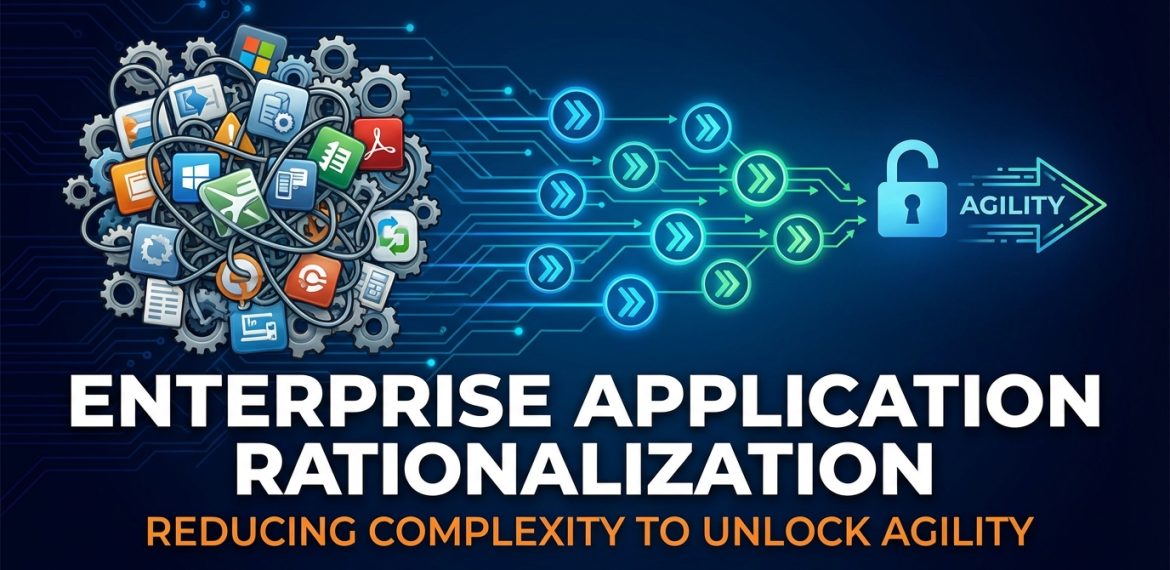
Enterprise Application Rationalization: Reducing Complexity to Unlock Agility
Enterprise Application Rationalization: Reducing Complexity to Unlock Agility
 Divyendra Kumar
 Over time, most organizations accumulate applications faster than they retire them. New business units adopt specialized tools, legacy systems remain in place for fear of disruption, and acquisitions introduce additional platforms into the ecosystem. What begins as a practical response to business needs gradually turns into a fragmented and costly application landscape.
Enterprise application rationalization is the structured process of evaluating, consolidating, modernizing, or retiring applications to reduce redundancy, improve efficiency, and align technology investments with business priorities. It is not simply a cost-cutting initiative. When executed strategically, it becomes a catalyst for agility, security, and operational clarity.
The Hidden Cost of Application Sprawl
Application sprawl rarely happens overnight. It builds incrementally as teams select tools independently, short-term fixes become permanent solutions, and outdated platforms continue running because “they still work.”
The consequences are significant:
Duplicate functionality across departments
Inconsistent data definitions and reporting
Higher licensing and infrastructure costs
Increased security exposure
Complex integrations and maintenance overhead
Slower response to business changes
Each additional application introduces new dependencies, integrations, and operational demands. Over time, the complexity itself becomes a barrier to innovation.
Why Rationalization Is Now a Strategic Priority
In a digital-first environment, agility determines competitiveness. Organizations must be able to launch new products, integrate partners, scale operations, and adopt emerging technologies quickly. A bloated application portfolio makes these goals difficult to achieve.
Rationalization enables leadership to answer critical questions:
Which applications truly support core business capabilities?
Which systems are redundant or underutilized?
Which platforms introduce unnecessary operational risk?
Where can consolidation improve efficiency and visibility?
By clarifying these answers, organizations gain control over their technology direction.
The Business Benefits of Application Rationalization
When executed methodically, application rationalization delivers measurable value across financial, operational, and strategic dimensions.
Financially, reducing redundant licenses and infrastructure lowers ongoing costs. Consolidated platforms reduce maintenance overhead and simplify vendor management.
Operationally, streamlined systems reduce integration complexity and improve data consistency. Support teams manage fewer platforms, increasing reliability and reducing troubleshooting time.
Strategically, a simplified application landscape enables faster modernization initiatives. Cloud migration, automation, analytics, and AI initiatives become easier to implement when foundational systems are aligned.
A Structured Approach to Rationalization
Successful rationalization begins with a comprehensive inventory of the current application portfolio. This includes identifying application purpose, ownership, usage levels, integration points, licensing costs, and technical dependencies.
Applications are then evaluated across multiple criteria, such as:
Business criticality
Functional overlap
Performance and scalability
Security and compliance posture
Integration complexity
Total cost of ownership
Based on this evaluation, organizations typically categorize applications into four groups: retain, modernize, consolidate, or retire.
This disciplined approach ensures decisions are data-driven rather than reactive.
Addressing Common Concerns
Application rationalization often raises concerns about disruption, data loss, or user resistance. These concerns are valid but manageable with proper planning.
Phased execution reduces operational risk. Clear communication helps users understand the benefits of change. Comprehensive testing ensures data integrity and system continuity.
Rationalization is not about abrupt elimination. It is about thoughtful evolution toward a more efficient and sustainable ecosystem.
The Role of Governance and Ownership
Long-term success depends on governance. Without clear ownership and oversight, application sprawl will re-emerge.
Organizations should establish governance frameworks that define:
Application approval and procurement standards
Ownership accountability
Lifecycle management policies
Periodic portfolio reviews
Governance ensures that rationalization becomes an ongoing discipline rather than a one-time project.
Rationalization as a Foundation for Modernization
Application rationalization often serves as the precursor to broader modernization initiatives. When the application portfolio is simplified and aligned, cloud migrations become smoother, integrations become cleaner, and digital transformation initiatives deliver greater impact.
A rationalized environment is easier to secure, monitor, and scale. It creates a stable platform upon which innovation can thrive.
How Buxton Can Help
Buxton Consulting supports organizations in evaluating and optimizing their enterprise application landscapes with a structured and business-aligned approach.
We conduct detailed portfolio assessments to identify redundancies, inefficiencies, and risk exposures. Our team works closely with business and IT stakeholders to align rationalization strategies with operational priorities and long-term goals.
Buxton assists with consolidation planning, modernization roadmaps, integration alignment, and execution support. By combining technical depth with strategic insight, we help organizations reduce complexity while maintaining stability and performance.
Conclusion
Enterprise application rationalization is not merely an exercise in simplification. It is a strategic initiative that enhances agility, reduces cost, and strengthens operational resilience.
As technology ecosystems continue to grow, organizations that actively manage and optimize their application portfolios gain a decisive advantage. Those that ignore complexity risk being constrained by it.
Rationalization transforms fragmented systems into a cohesive digital foundation capable of supporting sustainable growth.