
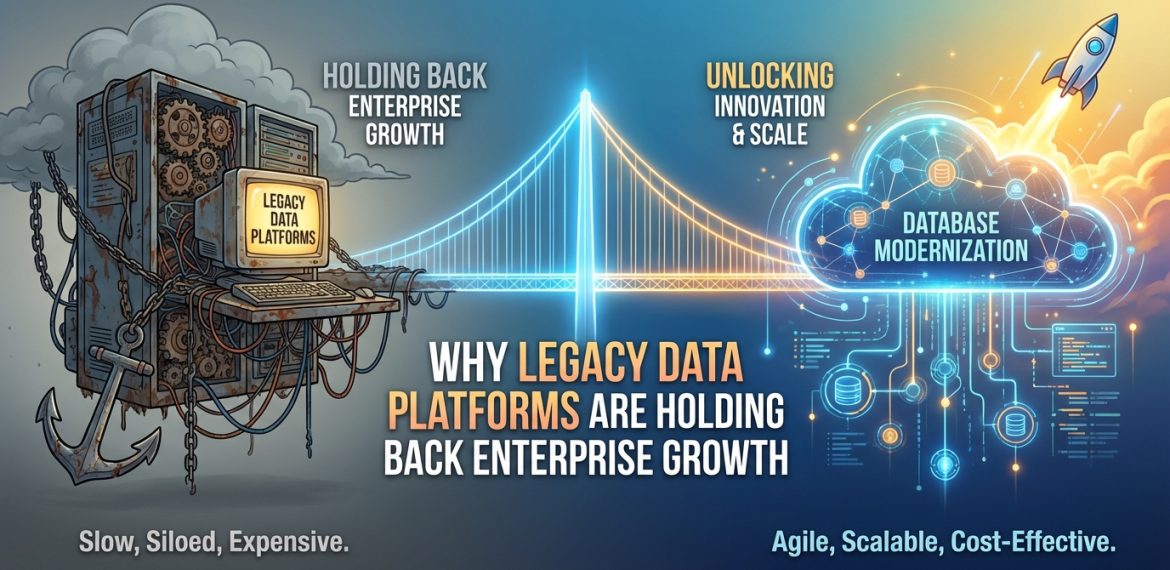
Database Modernization: Why Legacy Data Platforms Are Holding Back Enterprise Growth
Database Modernization: Why Legacy Data Platforms Are Holding Back Enterprise Growth
 Divyendra Kumar
 For many enterprises, databases are the silent backbone of operations. Finance systems, ERP platforms, CRM tools, e-commerce engines, analytics dashboards – all rely on stable and performant databases. Yet while front-end applications and cloud platforms evolve rapidly, database environments often remain unchanged for years.
Legacy database systems may appear stable on the surface, but over time they introduce performance bottlenecks, security risks, scalability limitations, and rising maintenance costs. Database modernization is no longer a technical upgrade – it is a strategic necessity for organizations that want to remain competitive, secure, and agile.
Why Legacy Databases Become a Business Risk
Legacy databases typically remain in place because “they still work.” However, stability does not equal readiness. As data volumes grow and applications demand real-time performance, older systems struggle to keep pace.
Common risks associated with legacy database environments include:
Performance degradation as data scales
Limited support for modern integration and analytics
Higher infrastructure and licensing costs
Security vulnerabilities due to outdated configurations
Difficulty supporting cloud-native applications
Over time, these risks compound, creating operational friction and limiting innovation.
The Shift Toward Cloud and Hybrid Database Architectures
Modern enterprises rarely operate in single-environment ecosystems. Applications run across on-premise systems, private clouds, and public cloud platforms. This hybrid reality demands database architectures that are flexible, scalable, and resilient.
Cloud-enabled database platforms offer advantages such as:
Elastic scalability based on demand
Built-in redundancy and high availability
Automated patching and maintenance
Integrated monitoring and analytics
Reduced infrastructure management overhead
However, modernization is not simply about migrating to the cloud. It requires careful planning to avoid cost overruns and performance issues.
Database Modernization Is More Than Migration
Many organizations mistakenly treat database modernization as a “lift and shift” exercise. Simply moving legacy systems to new infrastructure without architectural changes often replicates inefficiencies in a new environment.
True modernization involves:
Reviewing database architecture for scalability
Optimizing schemas and indexing strategies
Improving query performance
Enhancing backup and recovery mechanisms
Aligning security controls with modern standards
Modernization improves both the technical and operational dimensions of database environments.
Performance and Scalability in Data-Driven Enterprises
Today’s enterprises generate and consume data at unprecedented volumes. Customer interactions, IoT devices, supply chain systems, and analytics platforms continuously feed new data into databases.
Modern database strategies must support:
Real-time transaction processing
High-volume analytics queries
Integration with AI and machine learning workloads
Seamless data replication across environments
Low-latency access for customer-facing applications
Without modernization, database performance becomes a limiting factor for growth.
Security and Compliance in Database Environments
Databases store some of the most sensitive information within an organization – financial records, customer data, intellectual property, and operational metrics. Weak database security creates significant exposure.
Modern database strategies incorporate:
Encryption at rest and in transit
Role-based access controls
Continuous monitoring and auditing
Automated patch management
Compliance-aligned configuration standards
Security must be embedded within database operations rather than applied as an afterthought.
Operational Efficiency and Automation
Database management has traditionally been labor-intensive, requiring manual tuning, patching, and monitoring. Modern platforms enable automation that reduces operational overhead and improves reliability.
Automation can support:
Performance tuning recommendations
Automated scaling
Backup validation and recovery testing
Alerting and anomaly detection
By reducing manual effort, automation allows teams to focus on optimization and strategic improvements.
Challenges Organizations Face in Database Modernization
Despite its importance, database modernization is often delayed due to perceived complexity. Common concerns include downtime risks, compatibility issues, data migration challenges, and skill gaps.
Organizations may also face resistance due to comfort with legacy systems. However, postponing modernization often increases long-term risk and cost.
A structured approach that includes assessment, planning, testing, and phased execution significantly reduces these risks.
The Role of Managed Database Services
As database environments grow more complex, many organizations adopt managed database services to maintain performance and security without overburdening internal teams.
Managed database services provide:
Continuous monitoring and optimization
Proactive patching and updates
Backup and disaster recovery management
Performance tuning and troubleshooting
Compliance-aligned security management
This model ensures database reliability while enabling internal teams to focus on innovation.
How Buxton Can Help
Buxton Consulting supports organizations in modernizing and managing database environments that are secure, scalable, and aligned with business growth.
We begin with a comprehensive database assessment to evaluate performance, architecture, security posture, and operational maturity. Based on these insights, Buxton designs modernization roadmaps that balance risk, cost, and business priorities.
Our expertise spans database migration, optimization, security hardening, and ongoing managed database administration. By combining strategic planning with operational support, Buxton ensures that database modernization delivers measurable improvements in performance, reliability, and cost efficiency.
Conclusion
Databases may operate quietly in the background, but they power nearly every critical business process. As enterprises pursue digital transformation, cloud adoption, and data-driven decision-making, outdated database environments become a significant barrier.
Database modernization is not just a technical refresh – it is a strategic investment in performance, security, and scalability. Organizations that act proactively gain greater agility and resilience, while those that delay risk operational instability and competitive disadvantage.
Modern data demands modern database foundations. The sooner organizations recognize this, the stronger their digital future becomes.