
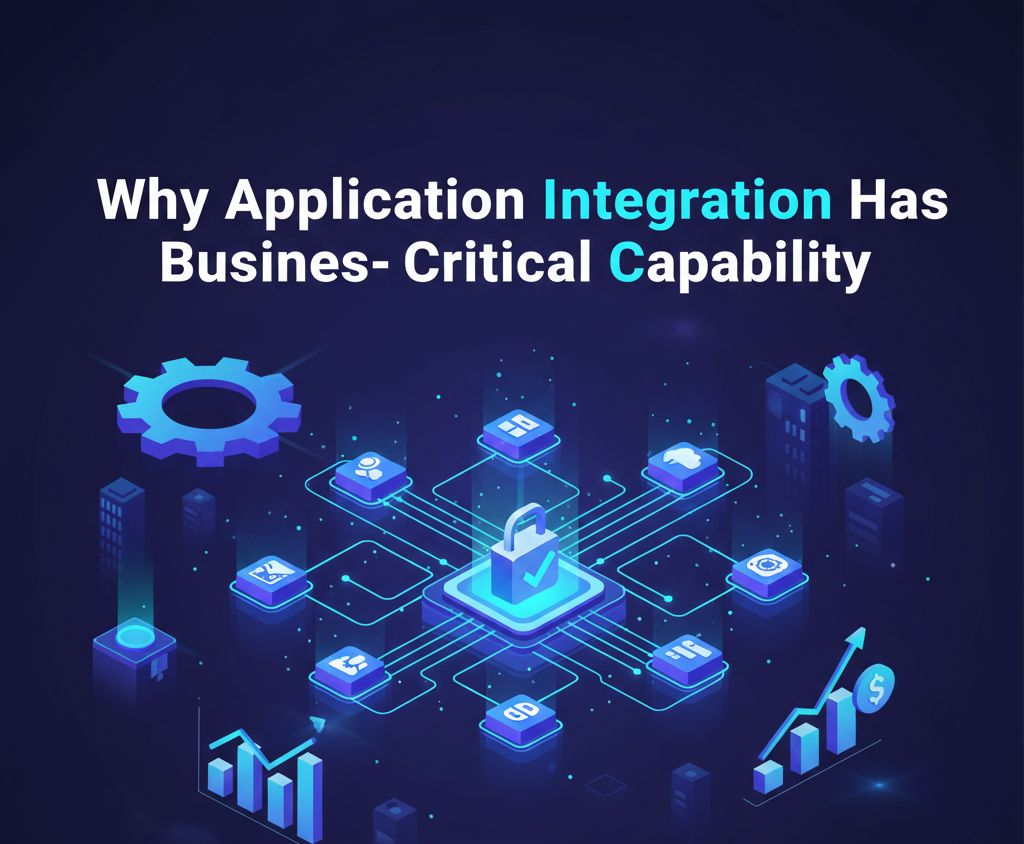
Why Application Integration Has Become a Business-Critical Capability
Why Application Integration Has Become a Business-Critical Capability
 Buxton Team
Modern enterprises no longer operate on a single system or platform. Over time, organizations accumulate ERP systems, CRM platforms, custom applications, cloud services, partner portals, and third-party tools. Each system may perform its role well in isolation, but without effective integration, the overall IT ecosystem becomes fragmented and inefficient.
Application integration is no longer a backend technical exercise. It has become a core business capability that directly impacts agility, visibility, customer experience, and operational efficiency.
The Reality of Fragmented Enterprise Systems
Most organizations today operate with a mix of legacy and modern applications. ERP systems may handle finance and supply chain, while cloud applications manage sales, HR, analytics, and customer engagement. Add acquisitions, regional systems, and industry-specific tools, and complexity increases rapidly.
Without strong integration, this fragmentation leads to:
-
Duplicate data across systems
-
Manual data transfers and reconciliations
-
Inconsistent reporting and decision-making
-
Delays in business processes
-
Higher operational and support costs
Over time, these inefficiencies compound and slow down the entire organization.
Why Point-to-Point Integrations No Longer Scale
In the early stages, many organizations rely on simple point-to-point integrations. While quick to implement, this approach becomes unmanageable as the number of systems grows.
Each new application increases integration complexity exponentially. Changes to one system often require changes across multiple interfaces, increasing risk and downtime.
Common challenges with point-to-point integrations include:
-
Lack of visibility into data flows
-
High maintenance overhead
-
Tight coupling between systems
-
Increased failure points
-
Difficulty supporting real-time use cases
As businesses scale, this model becomes a bottleneck rather than an enabler.
Integration as a Foundation for Digital Transformation
Digital transformation initiatives – whether cloud migration, automation, analytics, or AI – depend heavily on reliable data movement between systems. Integration acts as the connective tissue that allows these initiatives to succeed.
Strong integration enables:
-
Real-time data availability across platforms
-
Seamless customer and employee experiences
-
Faster onboarding of new applications
-
Consistent governance and data quality
-
Improved operational transparency
Without integration, transformation efforts remain isolated and fail to deliver end-to-end value.
Key Integration Patterns Used in Modern Enterprises
Modern integration strategies rely on well-defined patterns that balance flexibility, performance, and scalability.
API-Based Integration
APIs enable secure, reusable, and real-time communication between systems. They are essential for modern applications, mobile platforms, and partner ecosystems.
Event-Driven Integration
Event-based models allow systems to react to changes as they happen, improving responsiveness and reducing dependency on batch processes.
Middleware and Integration Platforms
Integration platforms centralize logic, monitoring, and error handling, reducing complexity and improving governance.
Data Integration and Synchronization
Data pipelines ensure consistent, reliable movement of data across systems for analytics, reporting, and operational use cases.
Choosing the right pattern depends on business requirements, data criticality, and system architecture.
Security and Governance in Application Integration
As integrations expand, security and governance become critical concerns. Each integration point introduces potential risk if not properly controlled.
Effective integration strategies address:
-
Secure authentication and authorization
-
Data encryption in transit
-
Error handling and audit logging
-
Access controls and role-based permissions
-
Compliance with regulatory requirements
Integration done without governance often becomes a hidden security vulnerability.
Operational Challenges in Managing Integrated Environments
Integration is not a one-time project. Integrated environments must be monitored, supported, and continuously optimized.
Common operational challenges include:
-
Silent failures where data stops flowing without alerts
-
Difficulty tracing issues across multiple systems
-
Lack of ownership across integration layers
-
Performance degradation under peak loads
Without proper operational models, integration complexity increases risk instead of reducing it.
Why Integration Requires Specialized Skills
Application integration demands a unique blend of skills across architecture, development, security, and operations. Generalist teams often struggle to manage integration at scale.
Specialized integration expertise helps organizations:
-
Design scalable integration architectures
-
Select appropriate tools and platforms
-
Ensure performance and reliability
-
Maintain security and compliance
-
Reduce long-term technical and operational debt
As integration becomes central to business operations, skill gaps in this area can significantly limit growth.
Integration as a Competitive Advantage
Organizations with strong integration capabilities operate differently. They respond faster to market changes, onboard partners quickly, and gain real-time insight into their operations.
Integration enables:
-
Faster product and service launches
-
Improved customer experiences
-
Better data-driven decision-making
-
Lower operational friction
-
Greater IT agility
Rather than being a technical cost, integration becomes a business accelerator.
How Buxton Can Help
Buxton Consulting helps organizations design, implement, and operate integration architectures that support scale, security, and business agility.
Our approach starts with understanding existing systems, data flows, and dependencies. We identify integration gaps, performance issues, and risks that limit operational efficiency.
Buxton supports organizations across:
-
Integration assessments and architecture design
-
API and middleware implementation
-
Enterprise application and data integration
-
Security and governance alignment
-
Ongoing operational support and optimization
By combining technical depth with operational expertise, Buxton ensures integration initiatives deliver measurable business outcomes – not just connectivity.
Conclusion
Application integration is no longer optional in modern enterprises. It is a foundational capability that determines how effectively organizations operate, innovate, and scale.
As systems continue to diversify, organizations that invest in structured, secure, and well-governed integration will gain a significant advantage. Those that ignore integration risk becoming slower, more complex, and less competitive over time.
Strong integration turns disconnected systems into a cohesive digital ecosystem – and enables IT to truly support business growth.